How GHK-Cu promotes collagen synthesis: the mechanism
GHK-Cu is essentially a courier — a tiny peptide that delivers copper into skin cells and flips a set of repair switches.
TL;DR
- GHK-Cu is a three-amino-acid peptide that binds a single copper ion.
- In published research, it shifts skin cells toward producing more collagen and less of the enzymes that break collagen down.
- Most clinical-grade evidence is on topical preparations; injectable evidence is smaller and less well-controlled.
What it is
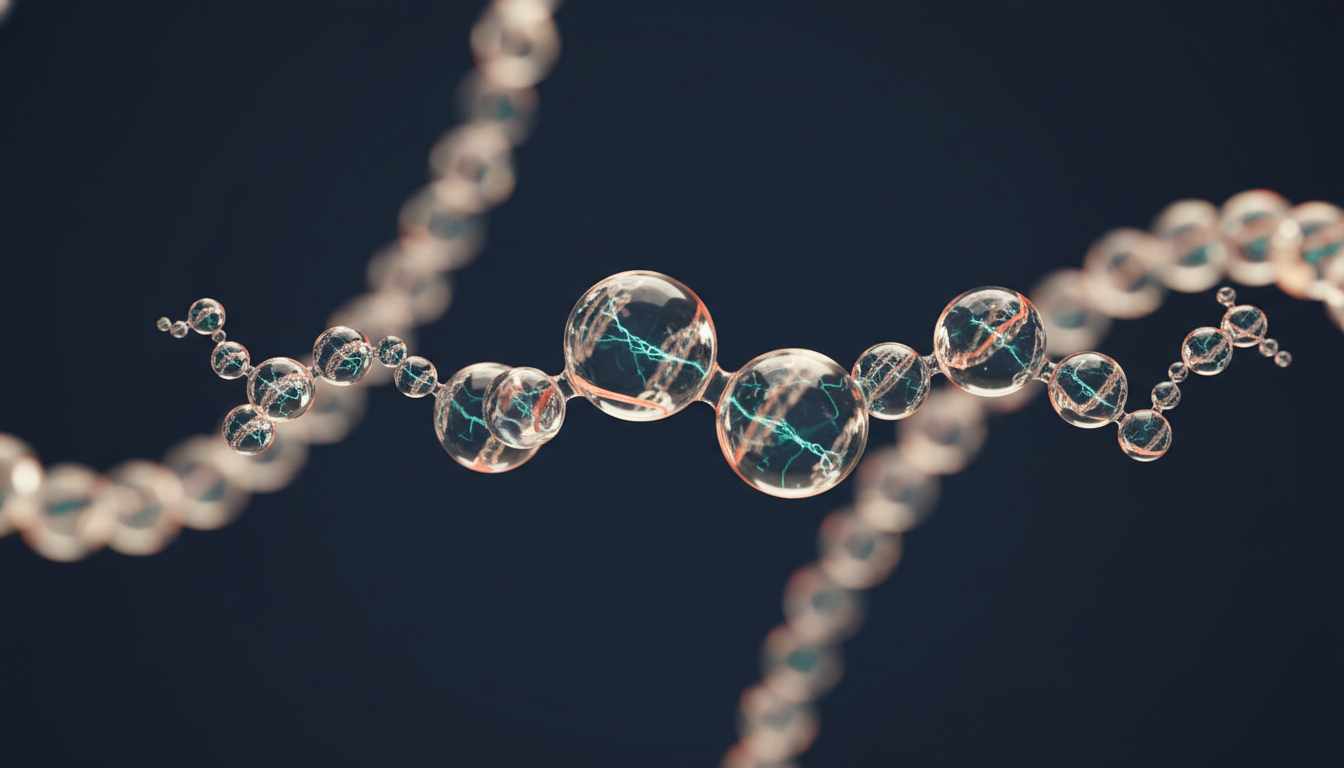
GHK-Cu is the shorthand for the tripeptide glycyl-L-histidyl-L-lysine bound to a single copper ion. In plain English: it is a tiny, three-letter sequence of amino acids that picks up a copper atom and carries it. The peptide was first identified in human plasma in the 1970s. Its concentration in blood declines with age, which is part of why it has become a common topic in skin-repair research.
How it works
Think of fibroblasts — the worker cells in the dermis (the deeper, thicker layer of skin under the surface) — as a small construction crew. They build collagen, which is the body’s structural cable. They also clean up old collagen using enzymes called matrix metalloproteinases (MMPs).
GHK-Cu acts as a small messenger that walks into the cell and changes which switches are on. In published gene-expression studies, GHK-Cu upregulates genes involved in extracellular matrix production and wound repair while downregulating genes for several MMPs. The copper ion is part of the active mechanism — copper is a required cofactor for several enzymes involved in collagen cross-linking and skin repair (Pickart et al., BioMed Research International, 2015).
Picture a thermostat: GHK-Cu does not pour in new collagen. It nudges the thermostat toward “repair.”
Who asks about it
People come to this question after seeing GHK-Cu marketed in skincare and wondering whether the mechanism is real or marketing. The short answer: the mechanism is well-described in the dermatology literature, mostly in cell culture and topical-delivery contexts.
What the research says
A representative review summarizes the gene-expression and wound-healing literature, including work showing GHK-Cu’s signaling effects on dermal fibroblasts and keratinocytes (Pickart and Margolina, Journal of Aging Research & Clinical Practice, 2012). Clinical evidence for topical formulations is more developed than evidence for injectable use.
What to know before considering it
Topical and injectable preparations are different products with different evidence. Any clinical use requires a licensed clinician evaluation.
The Halftime POV
The honest version of the GHK-Cu story is that the mechanism is real and well-studied, the topical evidence is reasonably solid, and the injectable evidence is younger and thinner. We try to keep those three sentences in their right order rather than collapsing them into one marketing claim.
Related reading:
- GHK-Cu: the copper peptide and skin biology
- GHK-Cu topical vs injection: different delivery different data
- Collagen synthesis: what the peptide literature actually shows
FAQ
Q: How does GHK-Cu promote collagen? A: GHK-Cu is a small peptide that carries a copper ion. In published in vitro and in vivo work, it appears to switch on a set of genes inside fibroblasts (skin cells that build collagen) and dial down the enzymes that break collagen apart. The combined effect is a shift toward repair.
Q: Why does GHK-Cu need the copper? A: Copper is the cargo. The GHK part of the peptide is the carrier. In the body, GHK pulls copper out of larger carrier proteins and delivers it where it is needed — copper is a cofactor for enzymes involved in skin repair and wound healing.
Q: Does GHK-Cu work the same in topical and injectable forms? A: Not exactly. The mechanism in skin cells is similar, but topical GHK-Cu acts mostly at the surface layers, while injectable GHK-Cu enters circulation. The two delivery routes have different evidence bases. Most published clinical research is on topical preparations.
Disclaimer
This article is educational and is not medical advice. Compounded medications are not FDA-approved. Clinical outcomes depend on individual factors and require physician evaluation. Results vary. Halftime Health is launching soon — join the waitlist to get updates.
Get updates
Halftime Health is launching soon. We’ll share what we learn along the way — the research, the regulations, the real-world trade-offs. Join the waitlist and we’ll email you when we’re live.
Sources
- Pickart L, Vasquez-Soltero JM, Margolina A. GHK Peptide as a Natural Modulator of Multiple Cellular Pathways in Skin Regeneration. BioMed Research International, 2015.
- Pickart L, Margolina A. The effect of the human peptide GHK on gene expression. Journal of Aging Research & Clinical Practice, 2012.
Sources & references
- pubmed.ncbi.nlm.nih.gov — https://pubmed.ncbi.nlm.nih.gov/26060403/
- pubmed.ncbi.nlm.nih.gov — https://pubmed.ncbi.nlm.nih.gov/22300670/