GHK-Cu vs hyaluronic acid: two different jobs in the skin
One signals the skin to rebuild. The other holds the water in. They are not rivals.
TL;DR
- GHK-Cu is a tripeptide (in plain English: a three-amino-acid chain) that binds copper and signals skin cells to make new collagen and matrix proteins.
- Hyaluronic acid is a sugar molecule (in plain English: a long polysaccharide) that holds water in the skin like a sponge.
- They do different jobs. Comparing them is like comparing scaffolding to a humidifier.
What it is
GHK-Cu is glycyl-l-histidyl-l-lysine bound to copper, a tripeptide first identified in human plasma in the 1970s. Hyaluronic acid is a long sugar chain naturally found in skin, joints, and connective tissue (Pickart, Biomed Res Int, 2012; Papakonstantinou et al., Dermato-Endocrinol, 2012). The first is a signaling peptide. The second is a structural water-holder.
How it works
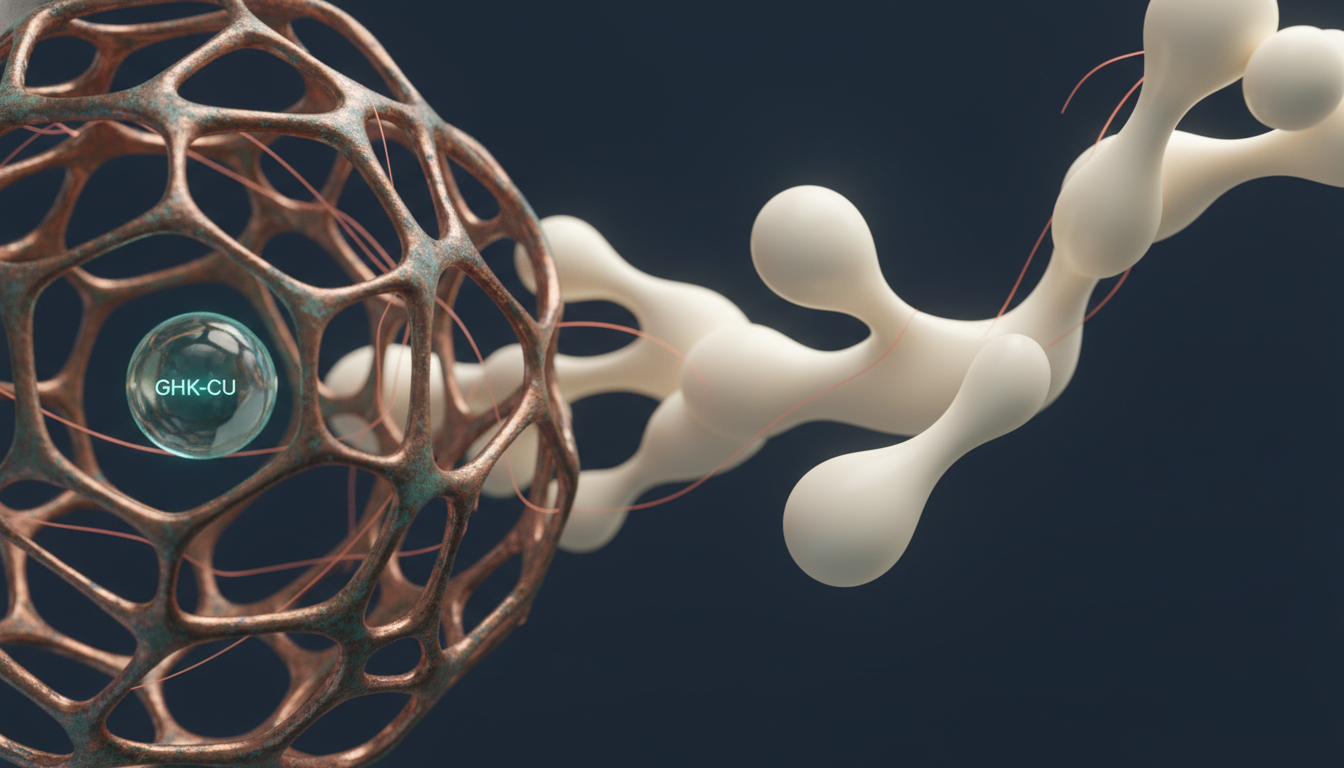
Picture a small construction site. GHK-Cu is the project manager who walks in, hands out work orders, and asks the crew (in plain English: the fibroblasts, your skin’s collagen-making cells) to start producing collagen, elastin, and glycosaminoglycans. Hyaluronic acid is the rooftop water tank — it does not change what the crew builds, but it keeps the site hydrated so everything works better. One is a signal. The other is a sponge.
Who asks about it
People usually ask this question when shopping for a skincare routine and trying to figure out which product to choose. The honest answer is rarely “one or the other.” It is more often “what problem are you trying to solve?” — collagen quality, hydration, or both.
What the research says
Topical GHK-Cu has been studied for collagen synthesis, wound healing, and visible skin firmness in small dermatology trials (Pickart, 2012). Hyaluronic acid has a much larger evidence base for hydration, plumping fine lines, and post-procedure recovery (Papakonstantinou et al., 2012). The two are routinely combined in cosmetic dermatology because they address different problems.
What to know before considering it
Topical GHK-Cu is sold as a cosmetic ingredient and is generally well tolerated; injectable compounded GHK-Cu is not FDA-approved and requires clinician oversight. Hyaluronic acid as a topical or filler is well tolerated for most skin types but should be discussed with a clinician for anyone with active skin conditions or planned procedures. Patch-testing any new active is reasonable.
The Halftime POV
The marketing wants this to be a fight. The biology is not a fight. Pick by problem, not by brand: signal the rebuild, then hold the water in.
Related reading:
- How GHK-Cu promotes collagen synthesis: the mechanism
- GHK-Cu vs retinol: how copper peptides and vitamin A compare
- Collagen synthesis: what the peptide literature actually shows
FAQ
Q: What is the difference between GHK-Cu and hyaluronic acid? A: GHK-Cu is a copper-binding tripeptide that signals skin cells to make collagen and other matrix proteins. Hyaluronic acid is a sugar molecule that holds water in the skin. GHK-Cu is a builder; hyaluronic acid is a sponge. They do different jobs and are not direct substitutes.
Q: Can you use GHK-Cu and hyaluronic acid together? A: In published cosmetic dermatology, the two are commonly layered. They work in different parts of the skin and target different problems — collagen signaling versus hydration. A clinician or licensed esthetician can guide a routine that suits a specific skin type.
Q: Is GHK-Cu FDA-approved? A: No. GHK-Cu is sold as a cosmetic ingredient at low concentrations and is registered with the FDA as a cosmetic, not as a drug. Compounded injectable GHK-Cu is not FDA-approved and requires a licensed clinician’s evaluation.
Disclaimer
This article is educational and is not medical advice. Compounded medications are not FDA-approved. Clinical outcomes depend on individual factors and require physician evaluation. Results vary. Halftime Health is launching soon — join the waitlist to get updates.
Get updates
Halftime Health is launching soon. We’ll share what we learn along the way — the research, the regulations, the real-world trade-offs. Join the waitlist and we’ll email you when we’re live.
Sources
- Pickart L. The human tripeptide GHK and tissue remodeling. Biomed Res Int, 2012.
- Papakonstantinou E, et al. Hyaluronic acid: a key molecule in skin aging. Dermato-Endocrinology, 2012.
Sources & references
- pubmed.ncbi.nlm.nih.gov — https://pubmed.ncbi.nlm.nih.gov/22070434/
- pubmed.ncbi.nlm.nih.gov — https://pubmed.ncbi.nlm.nih.gov/22361643/