What are peptides? A plain-English primer
Before you ask whether a peptide is right for you, it helps to know what a peptide actually is.
TL;DR
- Peptides are short chains of amino acids — the same building blocks that make up all proteins — typically 2 to 50 amino acids long.
- Your body already produces hundreds of peptides; they function as biological messengers, telling cells what to do.
- Insulin, discovered in 1921, is one of the most well-known peptides and remains a model for how the field developed.
What it is
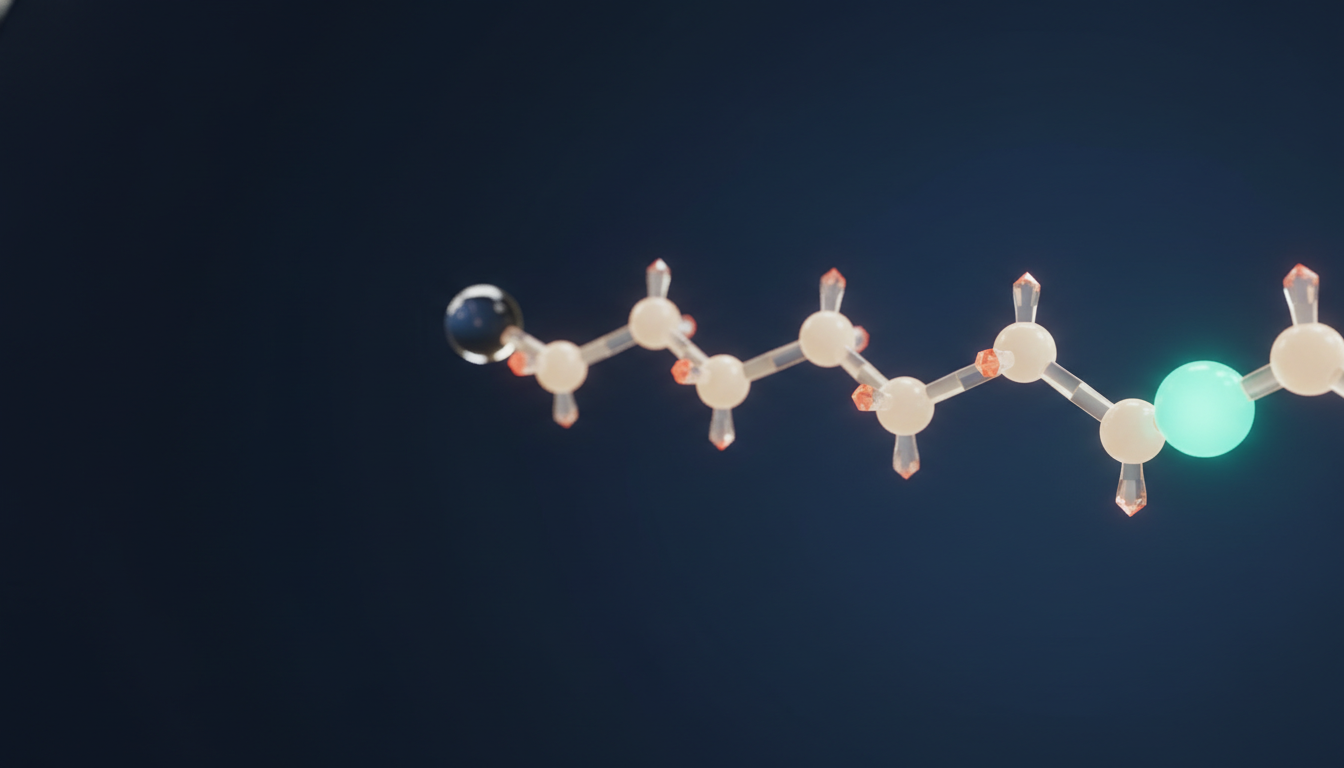
An amino acid is the molecular unit your body uses to build everything from muscle fiber to hormones. String two or more amino acids together with a chemical bond — called a peptide bond — and you have a peptide. String hundreds or thousands of them together and you have a protein.
The conventional dividing line: fewer than 50 amino acids is generally called a peptide; more than that is typically classified as a protein. That size difference matters for how a molecule behaves in the body and how it gets absorbed, cleared, and used.
Insulin — the hormone that regulates blood sugar — is a peptide of 51 amino acids. Its structure was first described in the early 1950s, building on Frederick Banting and Charles Best’s 1921 discovery that pancreatic extracts could lower blood sugar (Nobel Prize Committee, 1923).
How it works
Peptides function as messengers. They bind to specific receptors on the surface of cells — like a key sliding into a specific lock — and trigger a downstream biological response. A growth-hormone-releasing peptide, for example, binds to receptors in the pituitary gland and signals for growth hormone release. The specificity of that binding is what makes peptides interesting to researchers: a well-characterized peptide tends to have a narrow, predictable action rather than broad systemic effects.
Who asks about it
People come to this topic from many directions: someone who noticed the word “peptide” in a skincare label; someone researching growth hormone; someone whose physician mentioned sermorelin; someone trying to understand what compounding pharmacies actually dispense. The common thread is wanting a real explanation — not a marketing paragraph, and not a pharmacology textbook.
What the research says
Peptide research spans more than a century. Insulin remains the landmark example of a peptide discovered in nature and eventually synthesized for clinical use. Since then, hundreds of naturally occurring and synthetic peptides have been characterized. The National Institutes of Health maintains an active research portfolio across peptide hormones, immunomodulatory peptides, and receptor-targeted peptide analogs, documented across thousands of peer-reviewed publications in databases like PubMed (NIH National Library of Medicine, PubMed).
Key distinction researchers draw: endogenous peptides (made naturally by the body) vs. exogenous peptides (synthesized and introduced from outside). Most research-use and clinical-use peptides are synthetic analogs designed to mimic or modulate an endogenous peptide’s action.
What to know before considering it
Peptides are not supplements — they are biologically active compounds. In a prescription context, accessing a compounded peptide requires a licensed clinician evaluation, a valid prescription, and dispensing by a state-licensed pharmacy. Understanding the biology is a useful first step; it does not replace a clinician’s assessment of whether a given peptide is appropriate for your situation, health history, or goals.
The Halftime POV
Your body already speaks the peptide language. Hormones like insulin, oxytocin, and glucagon are all peptides. When researchers develop peptide-based therapies, they are largely working with signals your body already understands — attempting to amplify, supplement, or modulate what your own biology does naturally. That framing — working with physiology rather than against it — is the intellectual foundation for the entire field. It is worth understanding before you go deeper.
Related reading:
FAQ
Q: What are peptides? A: Peptides are short chains of amino acids — typically 2 to 50 amino acids long — linked by peptide bonds. Your body produces hundreds of them naturally; they function as biological messengers that tell cells what to do. Insulin, a 51-amino-acid peptide, is one of the most well-known examples.
Q: How do peptides differ from proteins? A: Peptides and proteins are made of the same building blocks — amino acids — but differ in chain length. Fewer than 50 amino acids is generally classified as a peptide; longer chains are proteins. This size difference affects how each behaves in the body, including absorption and clearance.
Q: Are peptides FDA-approved? A: Some peptides are approved drugs — insulin is the landmark example. Compounded peptides dispensed through licensed 503A pharmacies are not FDA-approved products. They are prepared from FDA-approved active pharmaceutical ingredients but are patient-specific preparations requiring a clinician evaluation and valid prescription.
Disclaimer
This article is educational and is not medical advice. Compounded medications are not FDA-approved. Clinical outcomes depend on individual factors and require physician evaluation. Results vary. Halftime Health is launching soon — join the waitlist to get updates.
Get updates
Halftime Health is launching soon. We’ll share what we learn along the way — the research, the regulations, the real-world trade-offs. Join the waitlist and we’ll email you when we’re live.
Sources
- The Nobel Prize in Physiology or Medicine 1923 — Banting and Macleod — Nobel Prize Committee
- PubMed — National Library of Medicine, NIH
- Peptide bond — National Center for Biotechnology Information, Biochemistry Reference
Sources & references
- pubmed.ncbi.nlm.nih.gov — https://pubmed.ncbi.nlm.nih.gov/
- pubmed.ncbi.nlm.nih.gov — https://pubmed.ncbi.nlm.nih.gov/