How peptides act on receptors: the key and lock explained
The mechanism behind every peptide protocol — described the way you’d explain it to a curious friend at the kitchen table.
TL;DR
- Peptides act like custom-cut keys that fit specific receptor “locks” on the surface of cells.
- When the key turns the lock, the receptor changes shape and starts a cascade of signals inside the cell.
- That specificity is why peptide drugs tend to do one thing precisely — and why side effects are typically narrower than with small-molecule medications.
What it is
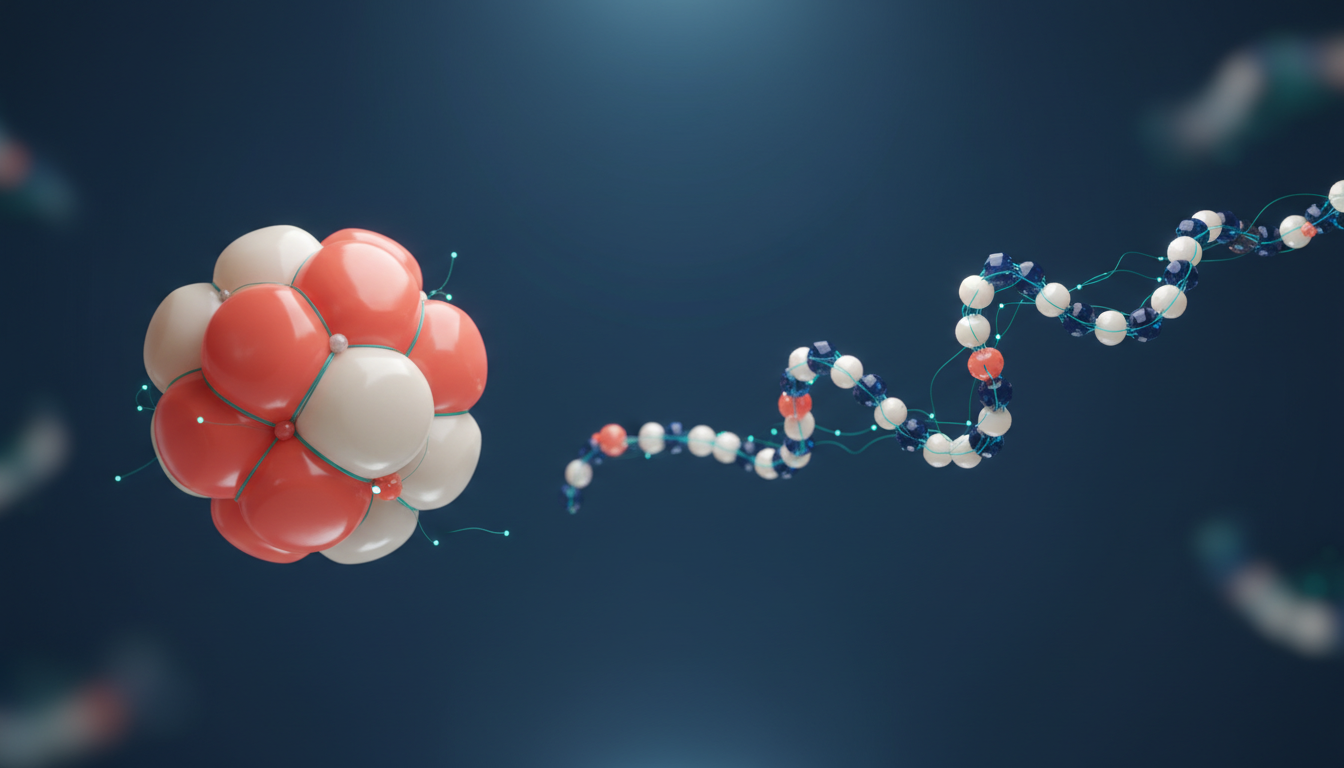
A receptor is a protein that sits on the outer wall of a cell with a small docking pocket facing outward. The pocket is shaped to fit one particular signaling molecule. Peptides are short chains of amino acids — large enough to have shape, small enough to move freely through the body. When the right peptide reaches the right receptor, it slides into that pocket. The receptor responds by changing its own shape on the inside.
How it works
The classic image is a key and a lock. A key by itself does nothing. A lock by itself does nothing. Insert the right key, turn it, and a chain of motion starts behind the door. Inside the cell, the “behind the door” part is a relay race called signal transduction. The receptor activates a partner protein inside the cell. That partner activates a second messenger — usually a small molecule like cyclic AMP. The second messenger activates enzymes that change what the cell is doing — releasing a hormone, copying DNA, building new structural protein (Lodish et al., Molecular Cell Biology — Cell-Cell Signaling, NIH Bookshelf).
Who asks about it
People come to this topic when they want to understand why one peptide does one specific thing — sermorelin asks the pituitary for growth hormone, GHK-Cu asks skin cells to make collagen, PT-141 asks the brain about desire — and how the same body can have so many different “locks” listening for different “keys.”
What the research says
Peptide-receptor interactions have been mapped at atomic resolution for decades. Most peptide drugs work through G-protein coupled receptors (GPCRs), the largest family of cell-surface receptors and the target of about a third of all FDA-approved medications. The specificity of the interaction explains why peptide-based drugs typically produce narrower side-effect profiles than small molecules (Lau JL, Dunn MK. Therapeutic peptides: Historical perspectives, current development trends. Bioorg Med Chem. 2018).
What to know before considering it
The key-and-lock model is a simplification. Real receptors flex, real keys can fit several related locks, and dose matters — too much of any signal, even a precise one, can desensitize the receptor or cause off-target effects. That is why dose, timing, and monitoring matter in any peptide protocol, not just the molecule itself.
The Halftime POV
Understanding the key-and-lock idea changes the conversation. It moves the question from “is this peptide good or bad” to “which lock does it open, and is that the lock you actually want opened.” That is the question a careful clinician helps a patient answer.
Related reading:
- What are peptides? A plain-English primer
- Peptides vs small-molecule drugs: keys vs hammers
- Receptor specificity: why peptides are more targeted
- How peptides differ from hormones
FAQ
Q: What is the key-and-lock model? A: It is a way of describing how a small molecule fits a specific receptor, the way a key fits a lock. When the right key (peptide) fits the right lock (receptor), the receptor changes shape and triggers a downstream signal inside the cell.
Q: Why are peptides so specific? A: Peptides are big enough and shaped enough to fit a single type of receptor, like a custom-cut key. Smaller drug molecules often fit several locks, which is why they more often produce side effects.
Q: What happens after a peptide binds its receptor? A: The receptor changes shape and starts a cascade — release of a second messenger inside the cell, activation of enzymes, and ultimately a change in what the cell does next, like releasing a hormone or rebuilding tissue.
Disclaimer
This article is educational and is not medical advice. Individual response varies. Halftime Health is launching soon — join the waitlist to get updates.
Get updates
Halftime Health is launching soon. We’ll share what we learn along the way — the research, the regulations, the real-world trade-offs. Join the waitlist and we’ll email you when we’re live.
Sources
- Lodish H et al. Molecular Cell Biology — Cell-Cell Signaling (NIH Bookshelf)
- Lau JL, Dunn MK. Therapeutic peptides: Historical perspectives, current development trends. Bioorg Med Chem. 2018
Sources & references
- ncbi.nlm.nih.gov — https://www.ncbi.nlm.nih.gov/books/NBK21726/
- pubmed.ncbi.nlm.nih.gov — https://pubmed.ncbi.nlm.nih.gov/29275816/