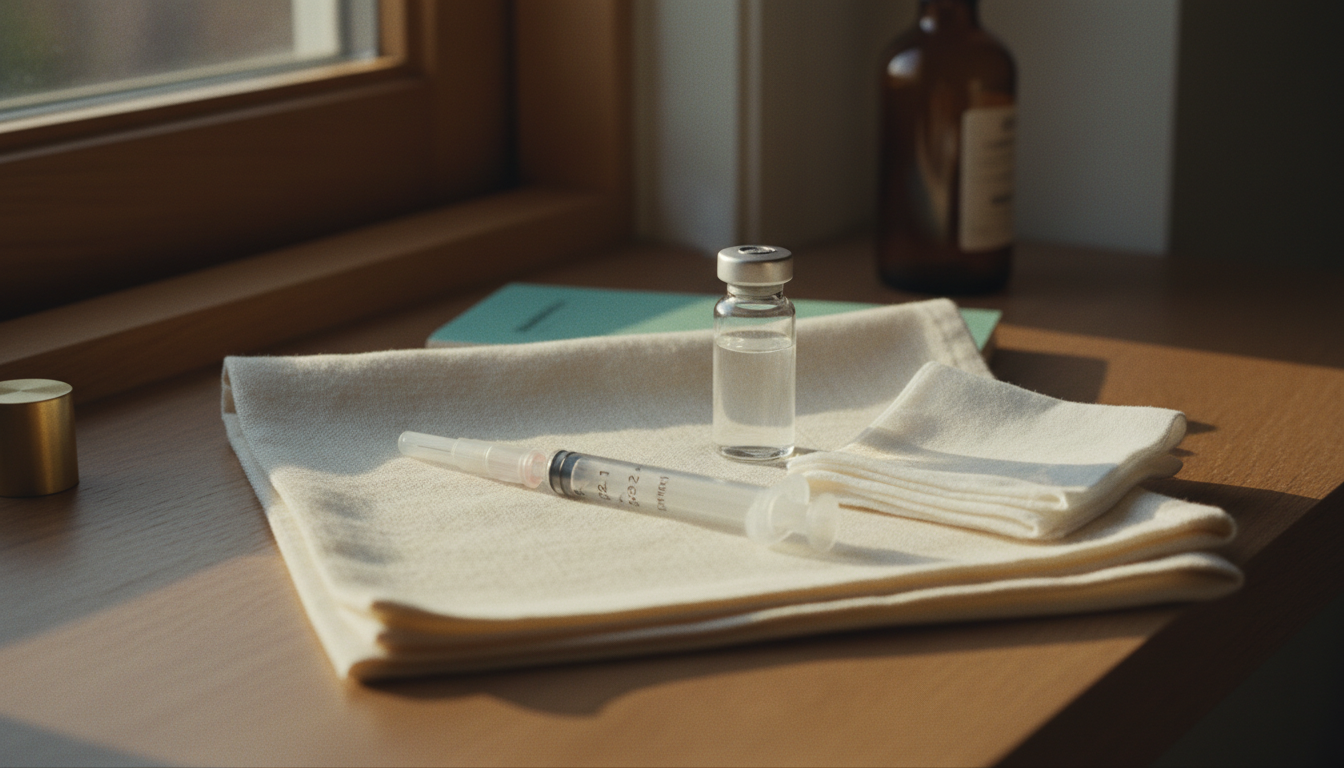
The complete reconstitution walkthrough, step by step
The peptide arrives as a powder. Reconstitution is simply turning it back into a measured liquid.
TL;DR
- Reconstitution means mixing a freeze-dried peptide powder with sterile water.
- Peptides ship dry because they stay stable longer that way.
- The process must stay sterile and the math must be exact, so follow your clinician’s instructions.
What it is
Reconstitution (in plain English: turning a dry powder back into a liquid) is how a freeze-dried peptide becomes injectable. The vial arrives as a small puck or powder. You add a sterile liquid, usually bacteriostatic water (sterile water with a tiny bit of preservative that limits bacterial growth). The powder then dissolves. Think of powdered baby formula. The dry form travels and stores well. You mix it with the right amount of liquid right before use (MedlinePlus: giving an injection).
How it works
The process is less like cooking and more like a careful lab step. Picture refilling an ink cartridge: the right fluid, the right amount, no mess. You draw a measured amount of sterile water into a syringe. Then you add it slowly down the inside wall of the vial, not straight onto the powder. Let it dissolve on its own. Do not shake it hard, because peptides can be fragile. How much water you add sets the strength of the dose. That is why the math has to match your prescription exactly (CDC: injection safety).
Who asks about it
People come to this topic the first time they see a peptide vial and realize it is not a ready-to-use liquid. They expected a pre-filled pen and got a powder instead. The natural questions follow: what do I add, how much, and how do I avoid messing it up? It is a practical, careful mindset, and exactly the right one for an injectable.
What the research says
This is a procedure, not a clinical claim. So the “evidence” here is good clean-handling technique. Sterility is the heart of it. Public-health guidance on clean injection practice stresses a few basics: clean hands, a clean surface, single-use needles, and wiping the vial top with alcohol before each entry. Accuracy is the other must. The dose strength depends on how much liquid you add. So one measurement error changes every dose that follows. Careful technique is what keeps a home injection both clean and correct.
What to know before considering it
Reconstitution should always follow the exact instructions from your clinician and pharmacy. That includes which liquid, how much, and how to store the mixed vial. Once mixed, many peptides need the fridge and last only a short time. Never reuse needles, and never share vials. And remember the bigger picture. Peptide access requires a licensed clinician. The powder in front of you should have come through that path, not an unregulated seller.
The Halftime POV
We remove the mystery, and reconstitution is a great example. It looks scary, but it is mostly about care and precision. Clean hands, the right water, the right amount, gentle mixing. When the steps are clear, the worry drops. Our goal is to make the hands-on parts of proactive medicine feel doable, always inside the guardrails of a licensed clinician and pharmacy.
Related reading:
- What peptides actually are
- Which biomarkers to track on a protocol
- Research-use-only vs physician-supervised peptides
FAQ
Q: What does reconstituting a peptide mean? A: It means mixing a freeze-dried peptide powder with a sterile liquid, usually bacteriostatic water, to make a solution that can be measured and injected. Peptides ship dry because they last longer that way.
Q: Why are peptides supplied as a powder? A: Many peptides are unstable in liquid for long periods. Freeze-drying keeps them stable in storage; mixing happens just before use, under your clinician’s and pharmacy’s instructions.
Q: Can I reconstitute a peptide myself at home? A: Any reconstitution should follow the exact instructions from your prescribing clinician and pharmacy. The process must stay sterile, and the math must be exact, which is why guidance matters.
Disclaimer
This article is educational and is not medical advice. Compounded medications are not FDA-approved. Clinical outcomes depend on individual factors and require physician evaluation. Results vary. Halftime Health is launching soon — join the waitlist to get updates.
Get updates
Halftime Health is launching soon. We’ll share what we learn along the way — the research, the regulations, the real-world trade-offs. Join the waitlist and we’ll email you when we’re live.
Sources
Sources & references
- cdc.gov — https://www.cdc.gov/injection-safety/hcp/clinical-safety/
- medlineplus.gov — https://medlineplus.gov/ency/patientinstructions/000425.htm