Needle gauge and length for peptide injections: a reference guide
Most peptide injections use a thin subcutaneous needle. Here is what the numbers actually mean.
TL;DR
- Most subcutaneous peptide injections use a fine 29G to 31G insulin syringe with a 1/2-inch (12.7 mm) or shorter needle.
- Higher gauge numbers mean thinner needles — counterintuitive, but useful to remember.
- The clinician’s prescription should specify the exact needle setup; this post is a plain-English reference, not a substitute for those instructions.
What it is
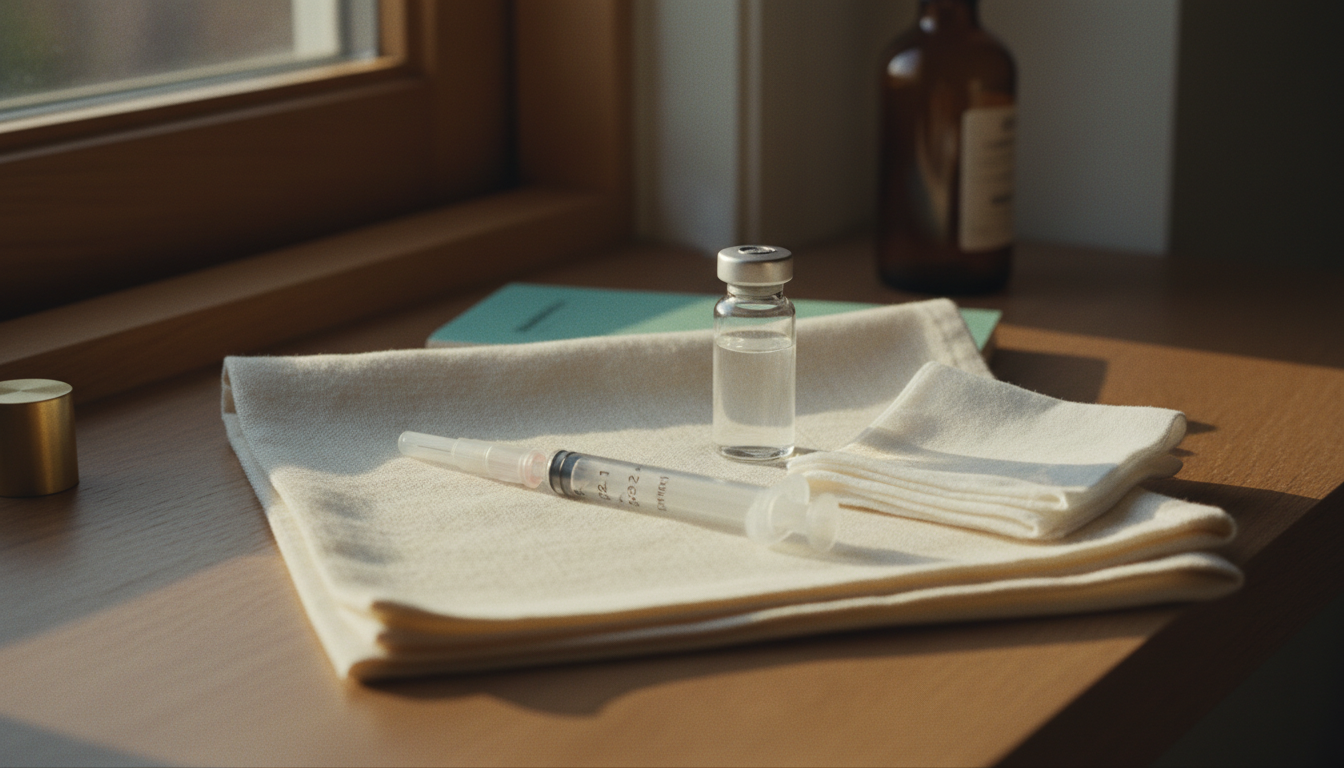
A subcutaneous needle (in plain English: a small needle designed to deliver medication into the layer of fat just under the skin) is the standard route for most peptide injections. The two numbers that describe a needle are gauge and length. Gauge is the diameter; length is how far the needle extends from the syringe hub.
A useful image: gauge is how thick a straw is. Length is how long the straw is. Both numbers shape the experience.
How it works
Subcutaneous tissue is the layer of fat just below the skin and above the muscle. Peptides delivered into this layer are absorbed slowly into circulation through small blood vessels in the area. Because the target depth is shallow, the needle needs to be short — typically 1/2 inch or less — and it does not need to be wide.
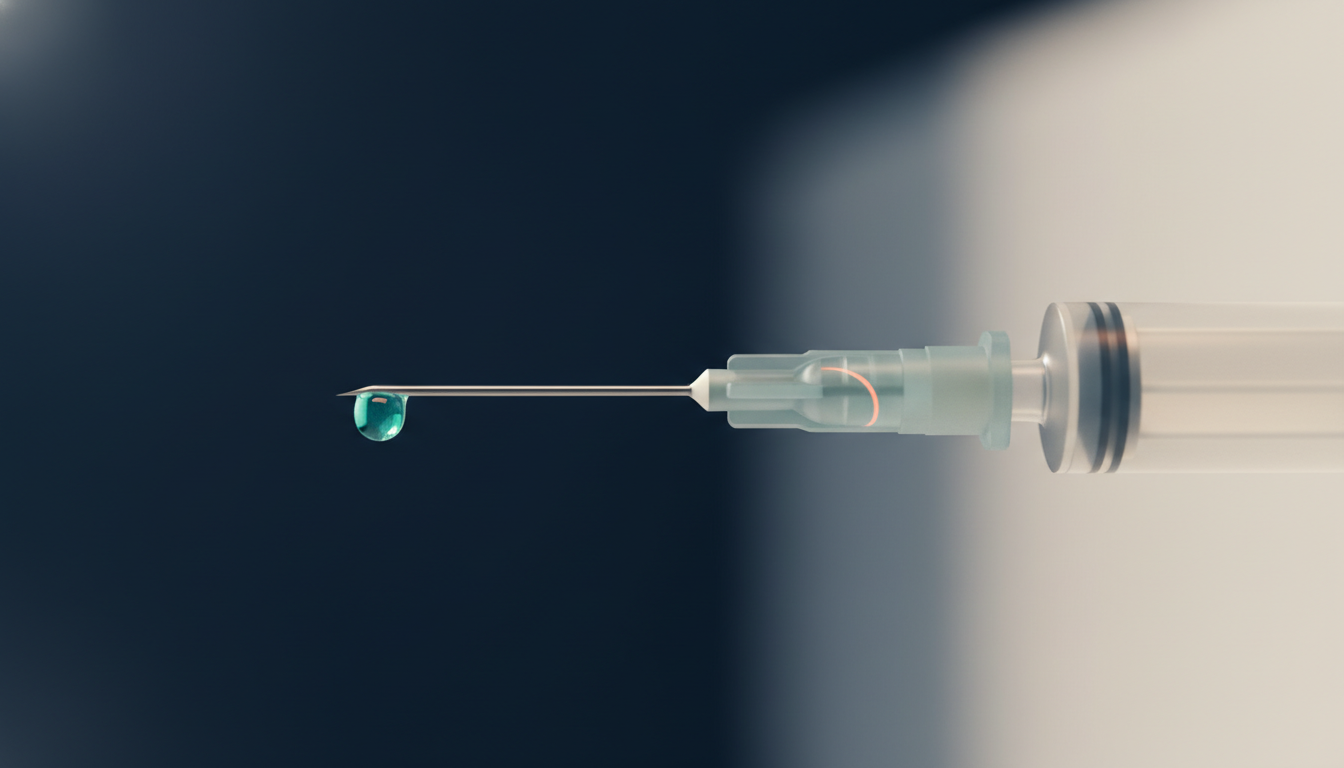
Gauge has a counterintuitive scale: higher numbers mean thinner needles. A 31G needle is thinner than a 27G needle. Thinner needles correspond to smaller skin punctures, which the published literature on injection comfort associates with less perceived pain (Iversen et al., Diabetes Therapy, 2019).
A typical peptide setup uses a 29G to 31G insulin syringe with an integrated needle. CDC injection-administration references describe similar gauge ranges for subcutaneous injections in vaccination contexts, supporting the same general principle (CDC — Needle Length and Site for Subcutaneous Injections).
Who asks about it
People come to this question right after they pick up a first prescription, or before — when they are trying to picture what self-injection actually involves.
What the research says
The clinical literature on injection technique consistently associates fine-gauge, short needles with comfortable, well-tolerated subcutaneous delivery. The same literature emphasizes site rotation and clean technique as the dominant drivers of injection-site outcomes — beyond gauge alone.
What to know before considering it
Specific gauge and length should follow the clinician’s and pharmacy’s instructions for the medication. Do not adjust needle size based on convenience or sourcing — the prescribed setup is part of the protocol.
The Halftime POV
The needle conversation is one of those topics that sounds technical and turns out to be simple. Thin and short is the rule for most peptide injections. The clinician sets the exact numbers. The job at home is to follow them and rotate sites.
Related reading:
- How subcutaneous peptide injections work
- Minimizing injection pain: what the research supports
- Injection site rotation: why it matters
FAQ
Q: What size needle is used for peptide injections? A: Most peptide protocols use a fine subcutaneous needle. A typical setup is a 29G to 31G insulin syringe with a 1/2-inch (12.7 mm) or shorter needle. The exact gauge and length should follow the prescribing clinician’s instructions.
Q: What does the gauge number on a needle mean? A: Gauge measures the needle’s outer diameter — but counterintuitively, a higher gauge number means a thinner needle. A 31-gauge needle is thinner than a 27-gauge needle. Thinner needles are typically associated with less injection-site discomfort.
Q: Can you use the same syringe for both reconstitution and injection? A: No. The needle used to draw bacteriostatic water and the API into a vial is typically larger and reused only for drawing. The injection itself uses a fresh, fine subcutaneous needle from a sealed syringe. The clinician or pharmacy should specify both needle types in the protocol.
Disclaimer
This article is educational and is not medical advice. Compounded medications are not FDA-approved. Clinical outcomes depend on individual factors and require physician evaluation. Results vary. Halftime Health is launching soon — join the waitlist to get updates.
Get updates
Halftime Health is launching soon. We’ll share what we learn along the way — the research, the regulations, the real-world trade-offs. Join the waitlist and we’ll email you when we’re live.
Sources
- CDC. Needle Length and Site for Subcutaneous Injections.
- Iversen L, et al. Patient experience with insulin pen needles of different lengths. Diabetes Therapy, 2019.
Sources & references
- cdc.gov — https://www.cdc.gov/vaccines/hcp/admin/needle-length.html
- pubmed.ncbi.nlm.nih.gov — https://pubmed.ncbi.nlm.nih.gov/30700013/