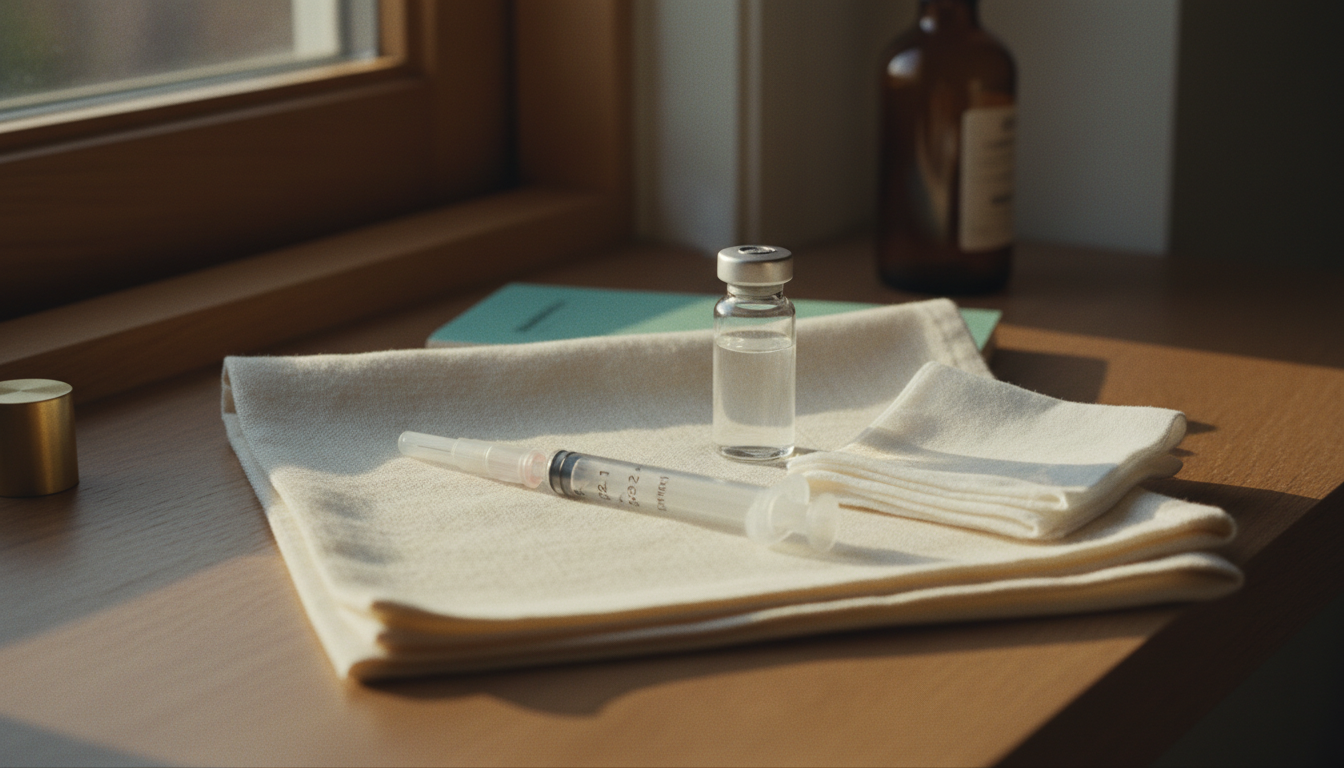
Who asks about peptide injection technique and why
The most common first question from someone starting a peptide protocol is not about the peptide. It is about the needle.
TL;DR
- Most people who start a peptide protocol have never given themselves an injection — and that is the first thing they want to understand.
- Subcutaneous injection (into fatty tissue just under the skin) is the most common route for peptides. The needle is small, and the process becomes routine quickly.
- The most important variables are reconstitution technique, sterile handling, and correct dose — not injection pain.
What people are asking about
The injection technique question usually comes from adults who are starting a compounded peptide for the first time. They have read about the peptide, spoken with a clinician, received their prescription — and then the vial arrives and they are confronted with the practical reality of self-injection.
These are not people with chronic disease who have managed injections for years. They are typically healthy adults in their thirties to sixties who have never done this before.
How subcutaneous injection works
Subcutaneous injection delivers a medication into the layer of fatty tissue directly beneath the skin — not into muscle (intramuscular) and not into a vein (intravenous). Think of it like injecting into a small pinch of skin you hold between your fingers.
The needles used for peptide injections are typically 29 to 31 gauge (in plain English: very thin — about the same diameter as an insulin needle) and 0.5 inches or shorter. At that gauge and depth, most people feel a brief sting that lasts a second or two. The anxiety going in is almost always larger than the sensation (NIH, Subcutaneous Injection, 2023).
Who asks about peptide injection technique
People come to this topic in two waves. The first is at the start of a protocol, before the first injection, when the needle feels like the most intimidating part. The second comes a few doses in, when they have a specific question — about a bubble in the syringe, injection-site redness, how to rotate sites, or what happens if they store the vial incorrectly.
Common areas of concern include questions about how to self-inject peptides correctly, how to reconstitute (dissolve) a lyophilized (freeze-dried) peptide with bacteriostatic water, how to draw and measure the right dose with a small syringe, which body site to use, and what normal vs. abnormal site reactions look like.
What the research says
Proper injection technique significantly reduces the risk of site reactions, lipodystrophy (localized fat or tissue changes from repeated injections in the same spot), and contamination. CDC injection safety guidelines emphasize single-use needles, sterile preparation, and proper disposal in an approved sharps container (CDC, Injection Safety guidelines, 2023).
Rotating injection sites — moving among the abdomen, upper thigh, and upper arm — reduces the risk of localized tissue changes from repeated injections in the same area.
What to know before starting
Your clinician provides specific instructions for your prescription. General technique education is helpful context — but the protocol details (dose, frequency, reconstitution ratio) come from the prescribing clinician, not a generalized guide. If something about the injection site looks different — persistent redness, swelling, or hardening under the skin — contact your clinician.
The Halftime POV
At Halftime Health, injection education is part of onboarding. We do not hand someone a vial and a syringe and send them on their way. Every member who injects gets a step-by-step guide from their clinician, and follow-up check-ins are built into the protocol. The injection is the easy part. The hard part is making sure the whole protocol is right for you in the first place.
Related reading:
- Injection technique primer
- Needle gauge guide for peptide injections
- Bacteriostatic vs sterile water: what to use
- Reconstituted peptide shelf life
- SubQ vs IM peptide injections: when each is used
FAQ
Q: Who asks about peptide injection technique? A: People starting a peptide protocol for the first time ask about injection technique. Most are adults who have never given themselves a subcutaneous injection and are anxious about doing it correctly. The questions center on which needle to use, where to inject, and how to handle reconstituted peptide vials.
Q: Is it hard to give yourself a peptide injection? A: For most people, subcutaneous injection (into the fatty tissue just under the skin) becomes straightforward within the first few attempts. The needle is very short and thin. Most people describe the initial anxiety as much larger than the actual discomfort of the injection itself.
Q: How do you self-inject peptides? A: Most peptides are given subcutaneously — into the pinched skin of the abdomen, thigh, or upper arm. The clinician prescribing your protocol provides detailed instructions. Basic steps include reconstituting the lyophilized (freeze-dried) peptide with bacteriostatic water, drawing the correct dose, and injecting at a 45 to 90 degree angle into the subcutaneous tissue.
Disclaimer
This article is educational and is not medical advice. Compounded medications are not FDA-approved. Clinical outcomes depend on individual factors and require physician evaluation. Results vary. Halftime Health is launching soon — join the waitlist to get updates.
Get updates
Halftime Health is launching soon. We’ll share what we learn along the way — the research, the regulations, the real-world trade-offs. Join the waitlist and we’ll email you when we’re live.
Sources
Sources & references
- ncbi.nlm.nih.gov — https://www.ncbi.nlm.nih.gov/books/NBK459304/
- cdc.gov — https://www.cdc.gov/injectionsafety/index.html