How peptides are reconstituted: bacteriostatic water basics
Most compounded peptides arrive as a freeze-dried powder. Before the first injection, you dissolve that powder into a liquid. This is reconstitution — and the liquid you use matters.
TL;DR
- Lyophilization (freeze-drying) stabilizes peptides for shipping and storage; reconstitution returns them to injectable solution.
- Bacteriostatic water (BAC water) contains 0.9% benzyl alcohol, which inhibits bacterial growth and extends the in-use shelf life of the reconstituted vial.
- Gentle swirling — not vigorous shaking — is the correct mixing technique. Shaking can physically disrupt peptide structure.
What it is
Lyophilization removes water from a peptide solution under vacuum, leaving behind a dry powder or cake. This form is stable at refrigerator or room temperature for longer periods than a liquid solution and survives shipping without cold-chain degradation. Before injection, that powder must be dissolved back into a sterile aqueous solution. The resulting liquid is what goes into the syringe. The US Pharmacopeia (USP) provides standards for injectable preparations, including the specification that diluent water used for compounded injectables must meet sterility and endotoxin requirements (USP General Chapter <1>, 2023).
How it works
Bacteriostatic water for injection contains 0.9% benzyl alcohol, a preservative that inhibits the growth of common bacteria. Once a vial of peptide is reconstituted with BAC water, the benzyl alcohol maintains the sterility of that multi-use vial across multiple withdrawal events — typically for up to 28 days when stored refrigerated. Sterile water for injection contains no preservative and is intended for single-use reconstitution only; a vial reconstituted with sterile water should not be accessed repeatedly. This distinction is practical, not theoretical: repeated needle insertions introduce contamination risk that BAC water’s preservative is designed to counter.
Who asks about it
People who’ve just received their first shipment of compounded peptides and found a powder vial alongside a separate water vial come to this question immediately. The two-vial format is unfamiliar if you haven’t handled compounded injectables before.
What the research says
Physical agitation of peptide solutions — vigorous shaking in particular — has been shown to induce aggregation and fibrillation in some peptide classes, effectively reducing the active fraction of the solution (Wang et al., Journal of Pharmaceutical Sciences, 2010). The practical guidance: add BAC water slowly along the vial wall, then swirl gently until the powder is fully dissolved. Never inject if the solution appears cloudy, particulate, or discolored.
What to know before considering it
Reconstitution introduces a point of potential error. Your prescribing clinician should provide specific reconstitution instructions for your protocol — including the target concentration and volume to draw for each dose. Using incorrect volumes changes the dose you receive. When in doubt, call the pharmacy.
The Halftime POV
The two-vial format feels clinical the first time. After two or three reconstitutions it’s as routine as measuring out any liquid. Understanding why the steps matter — why you swirl instead of shake, why BAC water preserves the vial longer — makes the process feel grounded rather than arbitrary. That context is worth having.
Related reading:
FAQ
Q: What is lyophilization and why does it matter? A: Lyophilization is a freeze-drying process that removes water from a peptide solution while preserving its structure. Most compounded peptides are shipped as lyophilized powder for stability and shelf life. Before injection, the powder must be reconstituted — mixed with a diluent — to create the injectable solution.
Q: Why is bacteriostatic water used instead of regular sterile water? A: Bacteriostatic water contains 0.9% benzyl alcohol, which inhibits bacterial growth. Because a multi-dose vial is punctured multiple times over days or weeks, the bacteriostatic agent prevents contamination between uses. Regular sterile water has no such preservation — it is appropriate for single-use reconstitution only and becomes a contamination risk in multi-dose protocols.
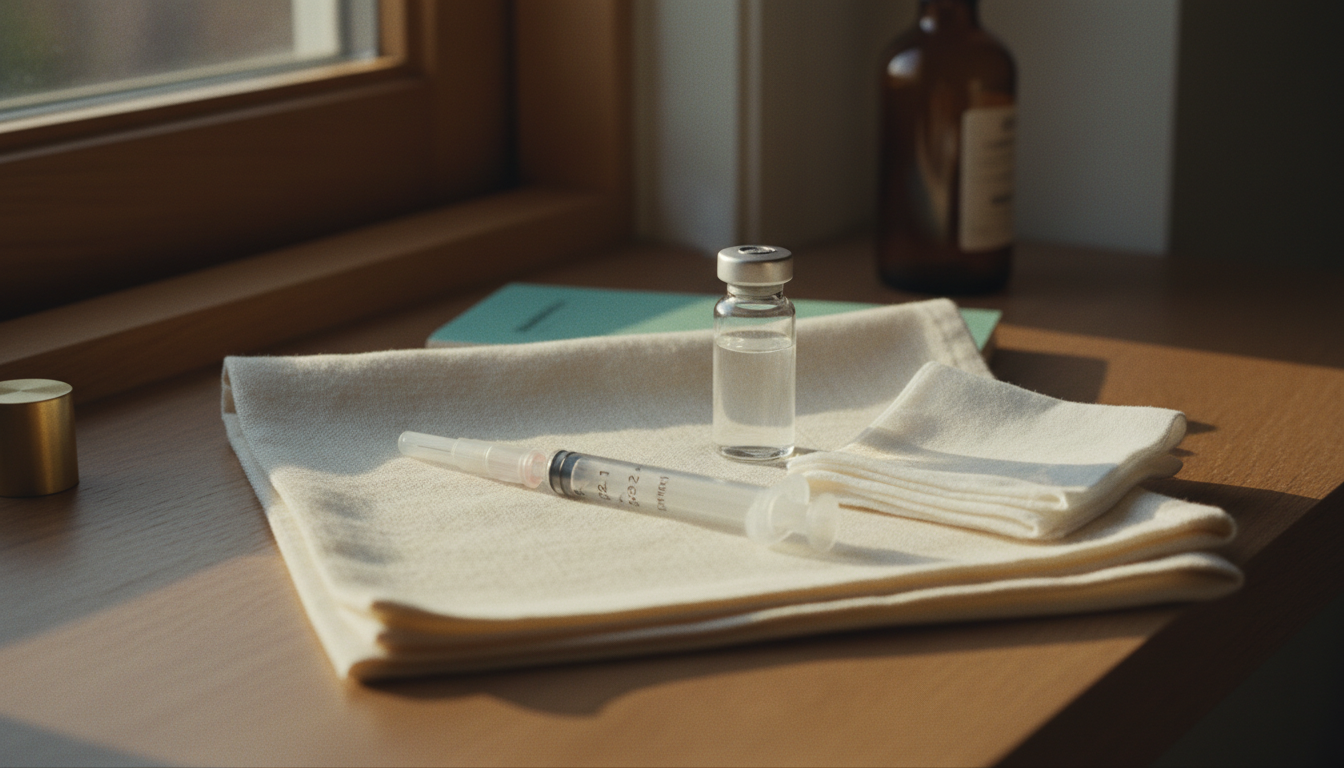
Q: How do you reconstitute a peptide vial? A: The standard process: wipe the tops of both the peptide vial and bacteriostatic water vial with an alcohol swab; draw the appropriate volume of bacteriostatic water into a syringe; inject it slowly down the inside wall of the peptide vial (do not inject directly onto the powder); gently swirl — do not shake — until dissolved; store refrigerated.
Disclaimer
This article is educational and is not medical advice. Compounded medications are not FDA-approved. Clinical outcomes depend on individual factors and require physician evaluation. Results vary. Halftime Health is launching soon — join the waitlist to get updates.
Get updates
Halftime Health is launching soon. We’ll share what we learn along the way — the research, the regulations, the real-world trade-offs. Join the waitlist and we’ll email you when we’re live.
Sources
- USP General Chapter standards for injectable preparations — US Pharmacopeia, 2023
- Wang W et al., “Protein aggregation and its inhibition in biopharmaceutics” — Journal of Pharmaceutical Sciences, 2010
- FDA Guidance on Bacteriostatic Water for Injection — FDA.gov
Sources & references
- pubmed.ncbi.nlm.nih.gov — https://pubmed.ncbi.nlm.nih.gov/19937726/
- pubmed.ncbi.nlm.nih.gov — https://pubmed.ncbi.nlm.nih.gov/19937726/